For ultra-high-net-worth individuals (UHNWIs) and family offices, a superyacht is a critical asset demanding rigorous technical protection, not merely aesthetic upkeep. True operational health requires uncompromising adherence to international maritime regulations to preserve the vessel’s structural integrity and market value. Delegating this technical compliance to a fully independent authority ensures financial predictability and eliminates operational blind spots.
The cornerstone of this standard is the International Safety Management (ISM) Code. By executing a meticulously tailored ISM safety management system yacht protocol, owners establish a quantifiable baseline for onboard safety, mitigating the risk of catastrophic mechanical failures and shielding the asset from the opaque billing structures common in traditional management.
The Strategic Value of the ISM Code in Asset Value Preservation
Often misconstrued as mere administrative procedures, the ISM Code serves as the definitive global benchmark for the safe management of vessels and pollution prevention. For superyacht owners and captains, the challenge lies in translating these international mandates into daily engineering practices. Implementing a safety management system based on the rigorous standards of the ISM Code establishes a solid foundation for ensuring the yacht’s technical compliance.
This framework mitigates operational risks by demanding standardized emergency protocols, proactive maintenance schedules, and highly transparent onboard communication channels. By applying clinical engineering precision to everyday operations, the ISM Code effectively transforms theoretical maritime safety into tangible asset protection. Without this foundation, vessels are exposed to severe operational inefficiencies, making a customized approach the next critical step.
Customizing an ISM Safety Management System for Maximum Yacht Operational Health
A generic, off-the-shelf SMS introduces critical vulnerabilities to your vessel’s operation. The SMS is the practical, day-to-day execution of the ISM Code, and it must be exclusively customized to the precise propulsion systems, bulkhead configurations, and operational realities of your yacht.
This tailored process involves:
- Technical Manuals: Drafting highly precise documentation specific to onboard machinery and engineering systems.
- DPA Protocols: Establishing strict Designated Person Ashore (DPA) frameworks to maintain constant shore-to-ship alignment.
- Continuous Monitoring: Implementing rigorous real-time onboard technical oversight and routine checks.
When owners opt for independent yacht management free from brokerage conflicts, the resulting ISM safety management system yacht protocols are executed with absolute objectivity. Every maintenance directive serves the yacht’s mechanical integrity rather than a third-party sales quota, seamlessly connecting proactive maintenance with the stringent audits required by maritime authorities.
How SMS Audits Prevent Non-Conformities (NCRs)
Failing Port State Control inspections or Class surveys due to technical negligence can instantly ground a superyacht. Such failures often manifest as Non-Conformities (NCRs), which severely compromise the yacht’s operational status and the validity of its insurance coverage. To prevent this, rigorous internal and external audits are non-negotiable. These audits act as deep-dive diagnostics, identifying microscopic gaps in the SMS before they evolve into critical liabilities.
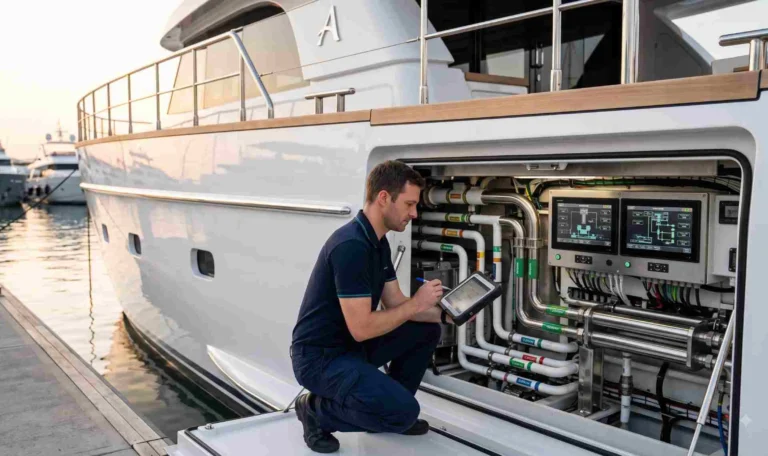
HYC World’s technical experts conduct proactive oversight, verifying that every bulkhead, engine component, and safety drill strictly exceeds international regulatory standards.
Preventing Non-Conformities (NCRs) Through Rigorous Audits
Failing a Port State Control inspection or Class survey due to technical negligence can instantly ground a superyacht. These operational failures typically manifest as Non-Conformities (NCRs), which compromise the vessel’s legal standing and invalidate insurance coverage.
Continuous internal and external audits proactively eliminate NCRs by delivering:
- Deep-Dive Diagnostics: Identifying microscopic technical gaps within the vessel’s safety architecture before they degrade into critical liabilities.
- Proactive Technical Oversight: Verifying that every engine component, structural bulkhead, and onboard safety drill strictly exceeds international regulatory standards.
- Cross-Jurisdictional Alignment: Safeguarding uninterrupted Class certification across foreign waters by understanding superyacht compliance requirements across regions.
In summary, expert technical management goes beyond basic compliance; it is a critical investment in your vessel’s operational health. Implementing a robust ISM safety management system yacht framework ensures your asset remains protected against mechanical degradation and financial ambiguity.
Discover the true standard of maritime mastery by visiting the HYC World website, and connect with us on our social media Facebook, Instagram, and Linkedin channels to ensure your asset is always in expert hands.
Frequently Asked Questions
What is the difference between the ISM Code and an SMS?
The ISM Code is the international regulatory framework established by the IMO for the safe management of vessels. An SMS (Safety Management System) is the specific, documented set of protocols and manuals implemented on your individual yacht to fulfill the ISM Code’s legal and technical requirements.
How often are SMS audits required for a superyacht?
Internal audits must be conducted annually by the management team to verify that the SMS is functioning efficiently. External audits, performed by Flag State or Class Society representatives, occur periodically according to the vessel’s specific statutory certification cycle to maintain legal compliance.
Why do SMS non-conformities (NCRs) affect yacht insurance?
An unresolved NCR signals a critical breach in mandatory safety protocols, which can instantly invalidate your Class certification. Because insurance providers mandate continuous compliance with Flag State and Class regulations, failing to rectify an NCR can void your coverage entirely in the event of an incident.